
Benazir Kafalat Eligibility Explained
Millions of families across Pakistan depend on the Benazir Kafalat Program for their quarterly financial support, and the rules around payments have changed quite a bit recently. If you registered years ago, the amount, the eligibility score, and even the way you collect your money look different today.
This article gives you a clear, updated picture of the Benazir Kafalat Program for 2026 the correct payment amount, who actually qualifies, and the exact steps to collect your installment without running into delays. We have based this on the latest confirmed figures from BISP so you are not relying on outdated numbers.
How Much Is the Current Benazir Kafalat Payment
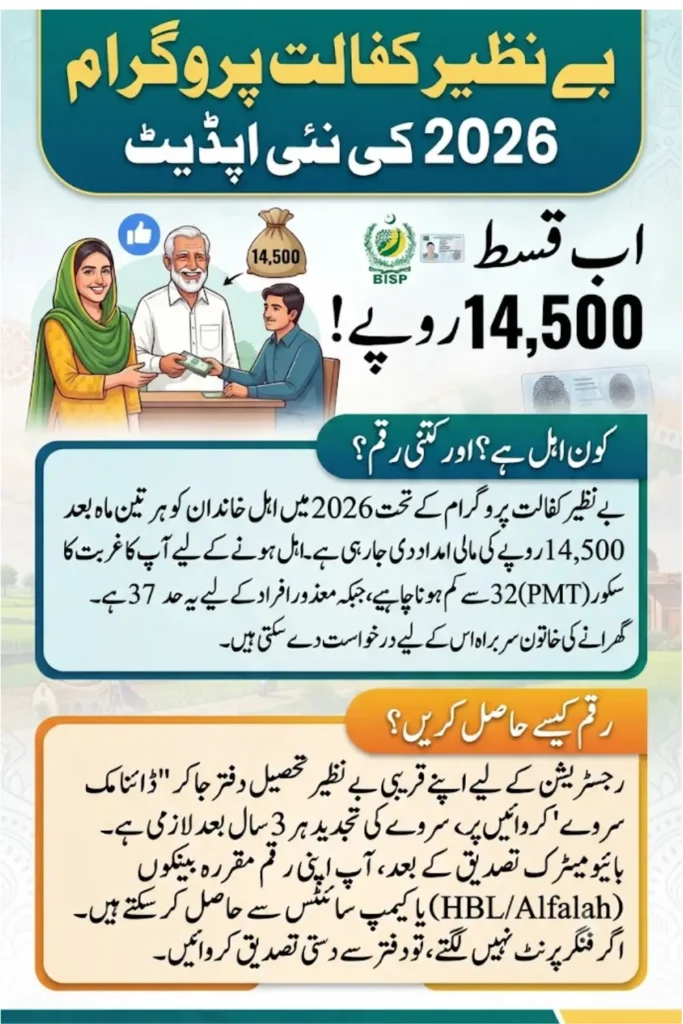
The quarterly stipend has moved up more than once in recent years. It started at just Rs. 3,000 per beneficiary when the program began in 2008, and has grown steadily since then as the cost of living rose. As of early 2026, BISP Chairperson Senator Rubina Khalid confirmed the amount had reached Rs. 14,500 per quarter for eligible beneficiaries.
This is not a one-time payment it is released every three months, and BISP currently supports close to 9 million families under this scheme, making it the largest single cash transfer program in Pakistan’s history. The exact amount you receive can still vary slightly depending on your region and whether you also qualify for linked programs like education stipends, so always confirm your specific figure through official channels rather than assuming a fixed number applies to everyone.
BISP 8171 Apply Online 2026: Step-by-Step Guide to Filling Application Form
Who Qualifies for the Benazir Kafalat Program
Eligibility is not decided by guesswork. BISP uses a scientific method called the Proxy Means Test, or PMT, which scores every household on a scale of 0 to 100 based on income, assets, and living conditions collected through the NSER survey. The lower your score, the more likely you are to qualify.
The current cut-off score for eligibility is 32, a limit set by the BISP Board back in September 2021 and still in use today. For families that include a person with a disability, this threshold is relaxed slightly to 37, giving them a better chance of qualifying even if their overall score is a bit higher.
Basic Eligibility Requirements
- Household must be a permanent resident of Pakistan with a valid CNIC issued by NADRA
- Monthly household income should generally fall below the government’s set threshold
- No immediate family member should hold a government job or receive a pension
- The household’s PMT score must fall within the approved cut-off, currently 32 (or 37 for families with a disabled member)
- Transgender applicants can apply without a PMT score limit, provided their CNIC reflects their gender and they complete the required survey
Registration Through the Dynamic Survey
Door-to-door surveys are no longer the main way people get registered. BISP has shifted to what it calls the Dynamic Survey, a real-time data update system available at BISP Tehsil Registration Centers across the country. This replaces the older method of waiting for a field team to visit your home.
If your household has never been surveyed, or if your last survey was completed three or more years ago, you need to visit your nearest Tehsil office to either register for the first time or refresh your data. BISP requires this data refresh roughly every three years to keep the beneficiary list accurate, so even existing beneficiaries occasionally need to redo this step to avoid their payments being paused.
Documents to Bring to the BISP Office
- Original, valid CNIC of the female head of household
- NADRA-issued B-Forms for all children in the household
- A recent electricity or gas bill for address verification
- Proof of monthly income, or a declaration of no formal income
- Disability certificate, if applicable, for any household member
How Payments Are Verified and Released
Every payment goes through Biometric Verification, meaning your fingerprint is matched against NADRA’s database before money is released. This is currently handled through two partner banks HBL for Punjab, Sindh, and Balochistan, and Bank Alfalah for Khyber Pakhtunkhwa, Gilgit-Baltistan, and Azad Kashmir. You can collect your payment at partner bank branches, authorized retailers, or designated BISP campsites.
If your fingerprint does not scan properly because of worn prints or a medical issue, you are not automatically disqualified. BISP allows beneficiaries to request manual verification at their Tehsil office in such cases, so the payment can still be processed without repeated failed attempts at a bank counter.
Checking Your Status Without Visiting an Office
You do not need to travel anywhere just to confirm whether you are eligible or when your payment is due. BISP offers two simple, free methods that work for most people, even without a smartphone.
| Method | How to Use It | What You Get |
|---|---|---|
| SMS to 8171 | Send your 13-digit CNIC (no dashes) | Instant reply on eligibility and PMT score |
| BISP Web Portal | Enter CNIC and captcha on the official site | Live status, PMT score, and last payment date |
What Your PMT Score Range Means
Understanding where your household falls on the PMT scale helps explain why some families qualify for full cash support while others only get access to related subsidies. Here is a simple breakdown of how the score generally works.
| PMT Score Range | What It Usually Means |
|---|---|
| 0 (unregistered) | Household has no NSER record; registration needed at a Tehsil office |
| Below 32 | Eligible for full Benazir Kafalat quarterly cash transfer |
| 32 to 37 | May qualify only with a disability in the household, or for related subsidy programs |
| Above 37 | Generally not eligible for direct cash assistance |
What Happens If a Beneficiary Passes Away
BISP has a Next of Kin policy in place for situations where a registered beneficiary dies. Instead of the household losing its financial support entirely, an authorized family member can apply to continue receiving the payment through a defined process at the Tehsil office. This ensures families are not left without support simply because the original registered person is no longer alive.
This policy matters because many households rely on Kafalat payments as a core part of their monthly budget, and a sudden loss of income on top of a family loss can be devastating. Families in this situation should visit their local BISP office as soon as possible with proof of the beneficiary’s passing and their own CNIC to start the transfer process.
BISP Student Continuation Grant 2026 for Primary to Higher Secondary Education
Frequently Asked Questions
Q1. What is the current Benazir Kafalat payment amount in 2026?
Eligible beneficiaries currently receive Rs. 14,500 per quarter, confirmed by BISP leadership in early 2026. This is paid every three months, not monthly.
Q2. What PMT score do I need to qualify?
Your household PMT score generally needs to be below 32, or below 37 if the household includes a person with a disability. Scores above this range are usually not eligible for cash assistance.
Q3. Do I need to visit my home area for a survey, or can I register elsewhere?
Registration now happens through the Dynamic Survey at any BISP Tehsil Registration Center rather than waiting for a door-to-door team. Existing beneficiaries also need to refresh their data roughly every three years.
Q4. What if my fingerprint fails during biometric verification?
You can request manual verification at your BISP Tehsil office instead of repeatedly retrying at a bank counter. This ensures a worn or damaged fingerprint does not block your payment permanently.
Q5. What happens to the payment if the registered beneficiary dies?
BISP’s Next of Kin policy allows an authorized family member to apply to continue receiving support. This process is handled at the local BISP Tehsil office with proper documentation.