
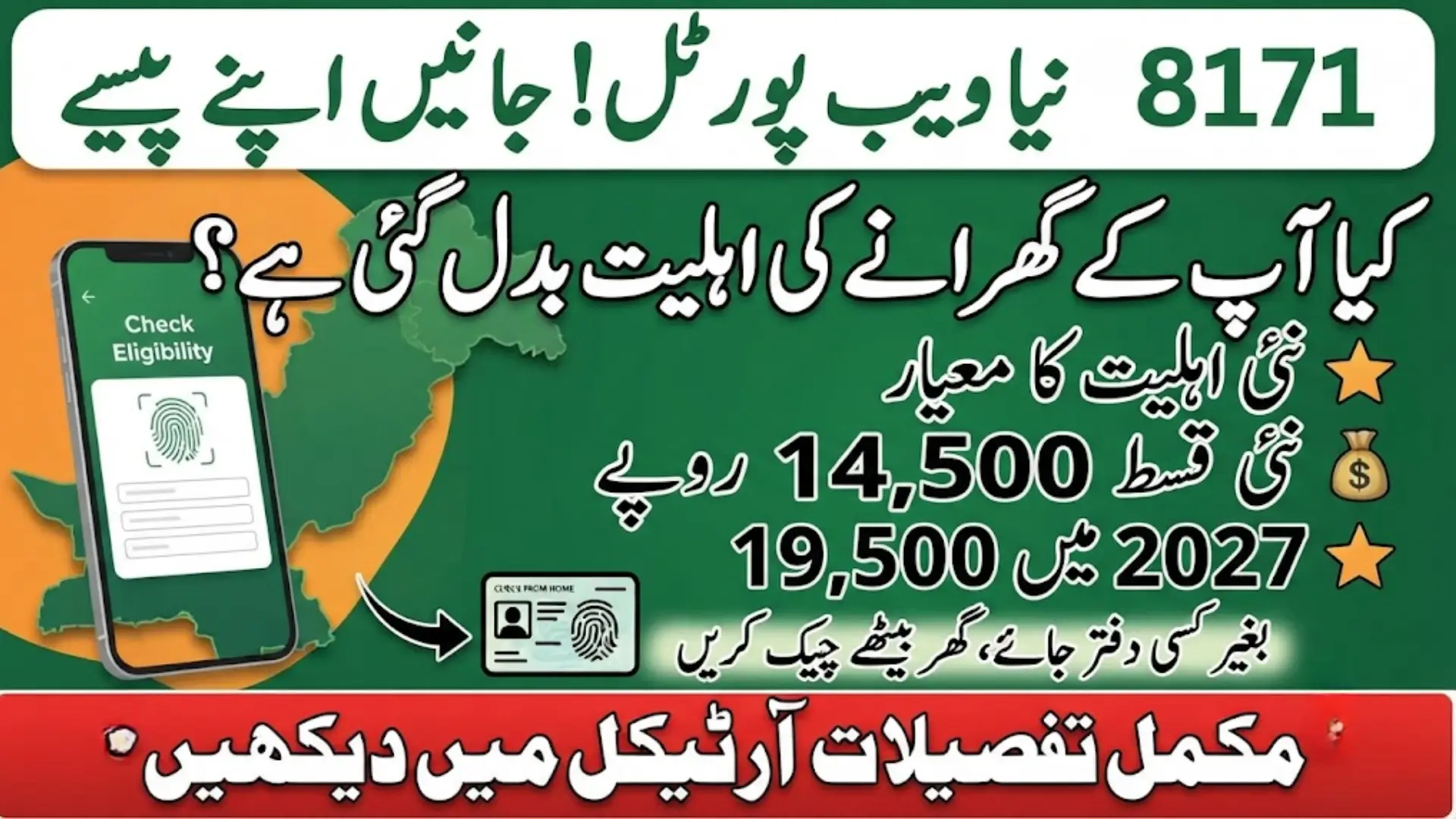
8171 New Web Portal
If you’ve heard people talking about “8171” and wondered what it actually means, you’re not alone. It’s the official number that Pakistan’s government uses to check eligibility and process payments under the Benazir Income Support Programme, commonly known by its earlier name, Ehsaas. Whether you send an SMS or open the web portal, the number 8171 connects you to the same system.
This guide walks you through how the 8171 web portal works today, what has changed since the program moved from Ehsaas to BISP, and how you can verify your registration or payment status without leaving your home. We’ll also cover the documents you need and answer the questions people ask most often.
What Is the 8171 Web Portal?
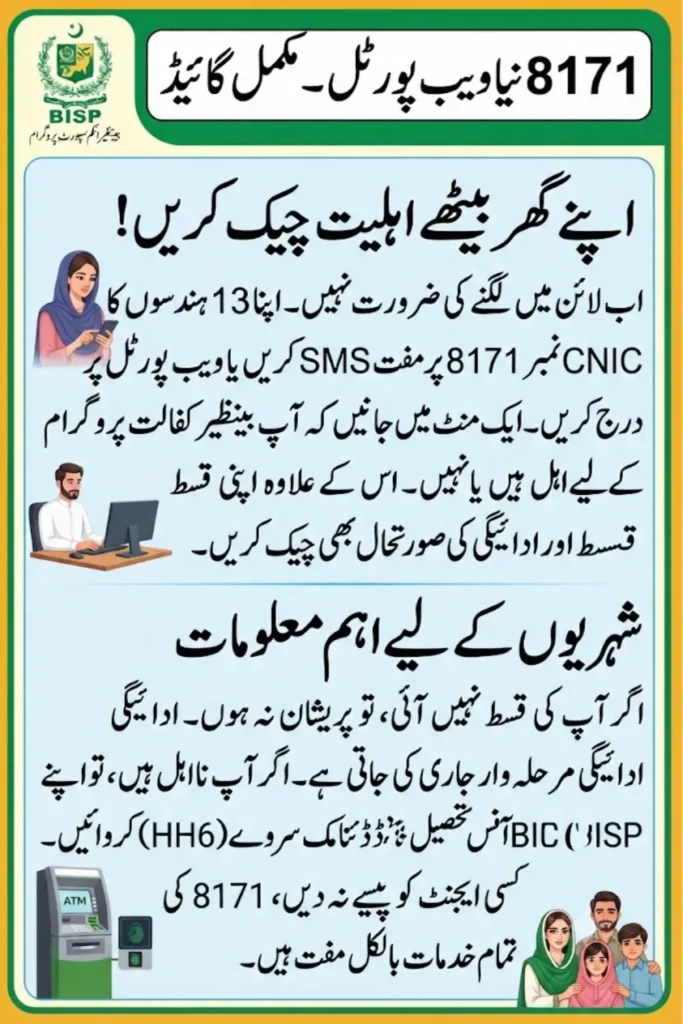
The 8171 web portal is the official online platform run by the Government of Pakistan that lets citizens check whether they qualify for financial help under the Benazir Income Support Programme. By entering a 13-digit CNIC number at the portal, people can instantly find out whether they are eligible for the quarterly cash stipend, check their payment status, and access information about registration and verification. The number 8171 works as both a website address and an SMS shortcode, so you can use whichever method suits you.
It’s worth clearing up some confusion here. The 8171 helpline and web portal now operate fully under BISP, which absorbed and replaced the Ehsaas Program after the change of government in 2022. So if you’ve searched for “Ehsaas 8171” or “Ehsaas CNIC check,” you’re still landing on the correct, single official channel there isn’t a separate Ehsaas portal running alongside it anymore.
8171 Ehsaas Program 14500 BISP News Online Registration Check By CNIC
How Online Verification and Registration Work
Checking your status online is simple once you know the steps. You don’t need to visit any office just to find out if you qualify, and that alone saves families hours of standing in line.
Checking Eligibility Through the Website
To verify your eligibility on the web portal, go to the official site, type in your CNIC number, complete the captcha shown on the screen, and press submit. The system then shows your eligibility status, your payment details, and whether your current installment has been released. This entire process usually takes less than a minute if the website is running smoothly.
Checking Eligibility Through SMS
Not everyone has reliable internet access, especially in rural areas, so the government kept the SMS option alive. You can send your 13-digit CNIC to 8171 from any mobile phone, and the service works on Jazz, Telenor, Ufone, Zong, and Warid, completely free of charge. Within a short time, you’ll get a reply telling you whether you’re eligible, not eligible, or still under verification.
If you’re not eligible according to the online or SMS check, it doesn’t always mean you’re permanently excluded it may just mean your household record needs updating through a fresh survey.
Registration and the Role of the Dynamic Survey
New applicants or families whose situation has changed need to register or update their information through what’s called a dynamic survey, sometimes shown on the portal as an “HH6” survey.
Who Needs to Register or Update Records
Families who were never surveyed, or whose last survey is old, often show up as ineligible even if their financial situation is genuinely poor. Households that have not completed a dynamic survey within the past two years typically have their payments automatically suspended. In such cases, the fix isn’t done online you have to visit your nearest BISP Tehsil Office in person with your original CNIC and request the survey.
Why Some Applications Get Rejected
Eligibility isn’t decided randomly. BISP relies on something called a Proxy Means Test, or PMT score, which estimates a household’s poverty level based on assets, income, and family size. Households whose PMT score rises above the eligibility threshold, often because of changes recorded during a dynamic survey, are removed from the active beneficiary list. Importantly, this score cannot be checked through the web portal or SMS; you need to visit a Tehsil office and request a PMT verification slip if you want to see it.
Payment Amounts and How Disbursement Works
Naturally, the most common question is: how much money do eligible families actually get, and when?
Current Payment Amount
As of mid-2026, the quarterly Benazir Kafalat stipend for eligible women stands at Rs. 14,500. This is paid out once every three months rather than monthly, so it’s meant to cover a household’s needs across the quarter rather than as a small recurring top-up.
How and When Payments Are Released
A common misunderstanding is that everyone receives money on the same date. In reality, BISP releases payments district by district in phases across the quarter rather than on one single national date. So if your status shows “not released yet,” it usually just means your district’s phase hasn’t started it doesn’t mean your payment has been blocked. Checking the portal every few days gives the most accurate, up-to-date picture for your specific CNIC.
Once your status shows “payment released,” you can collect the amount from designated collection points using your CNIC and biometric verification.
| Payment Method | Requirements | Notes |
|---|---|---|
| HBL Konnect point | CNIC + biometric verification | Widely available in most cities |
| Designated ATM | CNIC + biometric verification | Faster for tech-savvy beneficiaries |
| BISP payment center | CNIC + biometric verification | Best for rural or remote areas |
Documents You Need for Verification and Registration
Having the right paperwork ready before you start saves a lot of back-and-forth. Some documents are needed just for checking your status, while others are required only if you’re registering for the first time or updating your survey.
- Valid CNIC – the single most important document; an expired CNIC will block biometric verification even if you’re otherwise eligible
- Mobile number – needed for SMS-based checks and for receiving updates
- Proof of residence – such as a utility bill, used during registration and survey visits
- Proof of income or lack of income helps establish your PMT score accurately
- Family registration details – especially for households applying for the first time
Extra Documents for Special Cases
Certain categories, like people with disabilities, may need additional paperwork.
- Medical or disability certificate – required if applying under a disability-related category
- Bank account or wallet details – increasingly used since BISP has been shifting toward digital wallet payments for faster access to funds
Payment Trends: What’s Changing in 2026 and Beyond
The government has been steadily working on increasing support and making disbursements faster and more transparent.
| Period | Quarterly Amount | Status |
|---|---|---|
| April–June 2026 | Rs. 14,500 | phases |
| July–September 2026 | Rs. 14,500 (expected) | Active cycle |
| From January 2027 | Rs. 19,500 (approved) | Increase confirmed, not yet active Source:https://bisp.gov.pk/ |
The government has approved a further increase in the Benazir Kafalat quarterly stipend from Rs. 14,500 to Rs. 19,500, with that increase taking effect from January 2027. Until then, the current quarterly amount of Rs. 14,500 continues, and the July–September 2026 cycle is expected to remain at that same level.
Staying Safe From Scams and Fake Portals
Because BISP payments involve real money reaching vulnerable families, fraudulent websites and fake agents sometimes try to take advantage of confusion. Always rely on the official government portal rather than random links shared on social media or through unofficial WhatsApp groups.
Never pay any “agent” or middleman to register you, check your eligibility, or speed up your payment. The entire process, whether by SMS or the web portal, is free. If someone asks for money to “guarantee” your registration or payment, that’s a strong sign of a scam, and you should report it at your nearest BISP office instead.
8171 Pass Gov PK Online Registration For Getting 14500 Installment
Final Touch
The 8171 web portal has genuinely changed how ordinary Pakistani families interact with the Benazir Income Support Programme. What used to mean hours of waiting in line at an office can now often be done in minutes, either online or through a simple SMS.
Understanding how the dynamic survey, PMT score, and phased payment system work will help you avoid confusion and know exactly what steps to take if your status ever looks uncertain. As the government continues raising stipend amounts and digitizing payments, staying informed through official channels remains the best way to make sure your household doesn’t miss out.
Frequently Asked Questions
Is the 8171 portal the same as the old Ehsaas portal? Yes, there is no separate Ehsaas website anymore. BISP absorbed the Ehsaas Program, and 8171 now serves all beneficiaries under one system.
How much is the current BISP payment in 2026? Eligible women currently receive Rs. 14,500 per quarter, with an approved increase to Rs. 19,500 planned from January 2027.
Why does my status show “not released” even though others got paid? Payments are released district by district in phases, not all on one date, so your district’s phase may simply not have started yet.
Can I check my PMT score online? No, the PMT score cannot be checked through the web portal or SMS; you must visit your nearest BISP Tehsil Office in person.
What happens if I miss the dynamic survey? Your payments get automatically suspended if you haven’t completed a dynamic survey within the past two years, so you’ll need to visit a Tehsil office to update it.