
Ehsaas Program Door To Door Survey
If your family has never been able to register for financial help from the government, there is good news. The Ehsaas and BISP door-to-door survey has started again across Pakistan, and this time it is being carried out with better tools and wider coverage. Many households that were missed in earlier surveys now have another chance to get counted.
This new round of surveys, often called the NSER dynamic survey at the federal level and the PSER survey in Punjab, is meant to reach families in far-off villages and city slums that field teams could not visit before. In this article, we will walk you through everything you need to know: who is eligible, what documents you need, how the survey works, and how to check your status once you are registered.
What Is the Ehsaas Program and Why Does the Survey Matter
The Ehsaas Program is Pakistan’s social protection umbrella, built around the Benazir Income Support Programme (BISP), which sends quarterly cash payments to low-income households, mostly to women. Since 2019, Ehsaas has grown to include education stipends, food support, health cards, and emergency relief, but almost all of these schemes depend on one thing first: your household being properly recorded in the government’s socio-economic database.
That database is known as the NSER, or National Socio-Economic Registry, at the federal level, and as PSER, the Punjab Socio-Economic Registry, in Punjab province. Without an accurate, up-to-date entry in this registry, a family cannot be scored for eligibility, no matter how genuinely poor it is. This is exactly why the fresh door-to-door survey matters so much it is the gateway that decides who gets considered for cash support, ration cards, education stipends, and health insurance in the years ahead.
8171 New web Portal for Seamless Online Verification & Registration
Why the Survey Was Restarted
Years have passed since the last full national survey, and household situations change constantly. A family that was financially stable a few years ago might now be struggling because of job loss, illness, inflation, or the loss of a breadwinner. On the other hand, some once-eligible families may no longer need support. Old data simply does not reflect today’s reality.
There was also a coverage problem. In the earlier rounds, survey teams could not physically reach every street and village, so many deserving households were left out completely. The restarted survey fixes this in two ways: teams are revisiting areas that were missed before, and people can now also walk into their nearest BISP or PSER office to get surveyed instead of waiting for a team to knock on their door. This dual approach home visits plus walk-in registration is designed to make sure no eligible family is left behind.
How the New Survey Process Works
Door-to-Door Visits
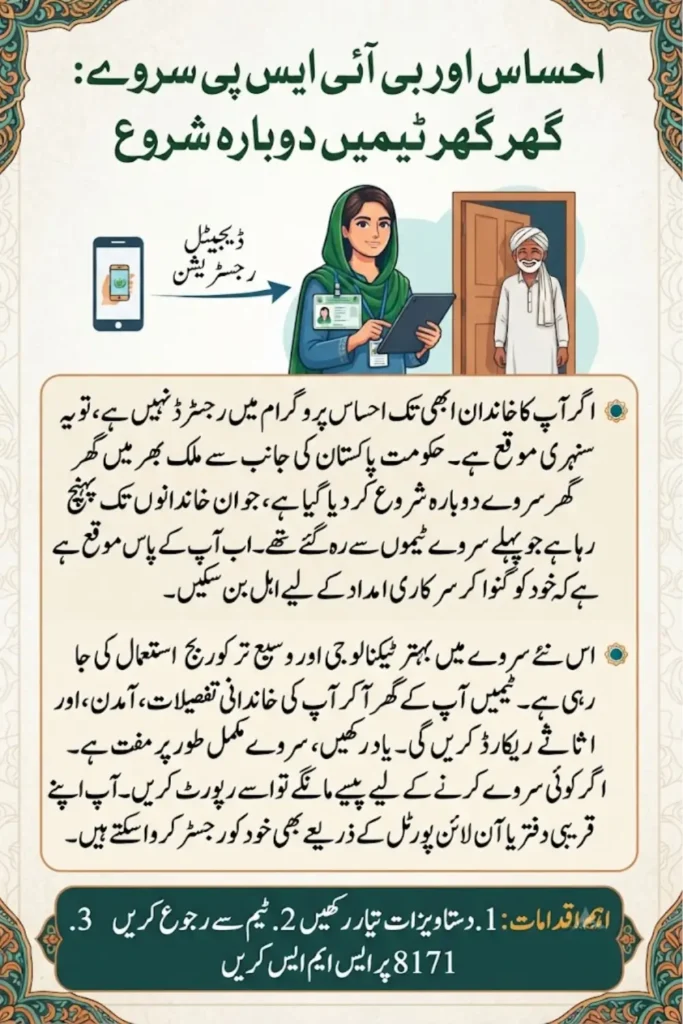
Trained survey staff, usually wearing official government identification and using tablets or mobile apps, are visiting homes in both rural and urban areas. They record family size, income sources, assets, living conditions, and other details that feed into a poverty scoring formula. In Punjab, this drive is being run under the PSER banner and has targeted several million households across the province.
The digital tools used this time are a real upgrade from the old paper-based surveys. Data is checked against NADRA records in real time, so CNIC details are verified instantly instead of being manually cross-checked later. Biometric verification is also used at many centers to stop the same person from being registered more than once, which was a common problem in the past.
Office-Based and Online Registration
Not everyone has to wait for a survey team. Families can now visit their nearest Tehsil-level BISP office or an Ehsaas facilitation point to complete their survey directly. You submit your documents, your details are entered into the system, and you get a token number to track your application. In Punjab, households can also start the process online through the official PSER portal and only need to visit a center for biometric confirmation.
This flexibility matters a lot for people in remote areas where survey teams take longer to arrive, and for anyone who was accidentally skipped during an earlier visit. It also gives people who moved house, got married, or had a change in income a straightforward way to update their record without waiting for the next official survey cycle.
Eligibility Criteria for the Ehsaas and BISP Survey
Eligibility is decided using something called a PMT score, or Proxy Means Test score. This is a number between 0 and 100 that is calculated from your income, assets, household size, and living conditions. The lower your score, the poorer your household is considered to be, and different programs use different cut-off points.
- Households with a monthly income below roughly Rs. 60,000 are generally considered for basic registration.
- A PMT score of around 32 or below is commonly required to qualify for BISP’s quarterly cash transfer.
- Widows, persons with disabilities, and women heads of households are given priority during registration.
- Families that were wrongly excluded in earlier surveys can now request a re-survey to correct their status.
- Daily wage earners and informal laborers are specifically encouraged to register through related labour-focused Ehsaas schemes.
Because cut-off scores can be adjusted from time to time based on budget and policy decisions, it is always a good idea to confirm your exact eligibility through the official 8171 SMS service or the BISP web portal rather than relying only on word of mouth.
Required Documents for Registration
Before visiting a survey team or a BISP office, it helps to have your paperwork ready so the process does not get delayed. Missing documents are one of the most common reasons applications get stuck or rejected at the verification stage.
- Valid, unexpired CNIC of the head of household
- NADRA-verified B-Form for children in the household
- Recent household electricity or gas bill
- Disability certificate, if applicable, for any family member
- Death certificate of a deceased husband, for widow applicants
- Proof of monthly income or a statement confirming no formal income
- Utility store or ration card details, if already available
Comparison: Federal NSER Survey vs. Punjab PSER Survey
Since people often confuse the two systems, here is a simple side-by-side comparison to make things clear.
| Feature | NSER (Federal, via BISP) | PSER (Punjab-specific) |
|---|---|---|
| Managed by | BISP / Ehsaas at federal level | Government of Punjab |
| Coverage | All provinces of Pakistan | Punjab province only |
| Registration point | Tehsil BISP offices, 8171 SMS/portal | PSER online portal, registration centers, door-to-door teams |
| Main linked benefit | BISP Kafalat quarterly cash transfer | CM Rashan Card, Taleemi Wazaif, Sehat Sahulat, Himmat Card |
| Verification method | NADRA cross-check, PMT scoring | NADRA sync, biometric checks, AI-based scoring |
| Status check | CNIC via SMS to 8171 | CNIC on PSER portal or provincial helpline |
How to Check Your Survey Status
Once you have completed your survey, whether through a door-to-door visit or a walk-in office registration, you will want to confirm that your data was actually recorded and processed. There are a few simple ways to do this without needing to travel back to an office every time.
For the federal NSER/BISP system, send your 13-digit CNIC number by SMS to 8171, and you will receive a reply telling you whether you are marked eligible and what your registration status is. The same check can be done through the official BISP web portal by entering your CNIC and a captcha code. For Punjab residents registered under PSER, the process is similar but goes through the dedicated PSER portal, where you log in with your CNIC and a one-time password sent to your mobile number.
احساس پروگرام 8171 آن لائن رجسٹریشن نئی اپ ڈیٹ 2025-26: مکمل تفصیلات جانیں
Timeline: What Has Happened So Far in 2026
| Period | Development |
|---|---|
| January 2026 | PSER door-to-door survey resumes in Punjab with digital data collection tools |
| February–April 2026 | Survey expands across more Punjab districts; NADRA and biometric integration rolled out |
| June 2026 | Federal Ehsaas/BISP dynamic survey cycle reopens for households missed earlier or previously rejected |
| August 2026 | PSER survey pushes into remaining rural and urban pockets, targeting over 30 lakh households |
Common Mistakes to Avoid During Registration
Many applications get delayed or rejected simply because of small, avoidable errors. Watch out for these before you submit your details:
- Submitting an expired CNIC, which causes automatic rejection on both NSER and PSER systems
- Giving an incorrect or mismatched mobile number, since OTPs and status alerts are sent to it
- Under-reporting or over-reporting household income, which can distort your PMT score
- Ignoring the survey token or reference number given after registration, making it hard to track progress later
- Trusting unofficial agents who ask for money to “guarantee” approval registration itself is always free
Conclusion
The restarted Ehsaas door-to-door survey, running alongside the provincial PSER drive in Punjab, is a genuine second chance for families who were left out of the social safety net before. Whether a survey team visits your home or you walk into a Tehsil office yourself, the goal is the same: an accurate, verified record that decides your eligibility for BISP payments, education stipends, and other relief programs.
Keep your documents ready, register through official channels only, and use the 8171 SMS service or the relevant online portal to track your status. Taking these simple steps now can make a real difference to your family’s financial support in the months ahead.
Frequently Asked Questions
Q1. Who is eligible for the new Ehsaas door-to-door survey? Households with a monthly income below around Rs. 60,000 and a low PMT score, including widows, disabled persons, and daily wage workers, are generally eligible. Final eligibility depends on your verified score after the survey.
Q2. Do I have to wait for a survey team to visit my home? No, you can also visit your nearest Tehsil BISP office or a PSER registration center in Punjab to complete your survey directly. Online self-registration is also available through the official portals.
Q3. How can I check if I have been registered successfully? Send your 13-digit CNIC to 8171 for the federal BISP system, or log in to the PSER portal with your CNIC for Punjab-specific registration. Both methods give an instant status update.
Q4. What documents do I need for the survey? You need a valid CNIC, NADRA B-Forms for children, utility bills, proof of income, and any relevant certificates such as disability or death certificates. Missing documents can delay your application.
Q5. Is there any fee to register in the Ehsaas or PSER survey? No, registration is completely free of cost through official government channels. Be cautious of anyone asking for payment to “speed up” or guarantee your approval.
BISP 8171 Result Check Online By CNIC Easily Through Portal Know Complete Process