
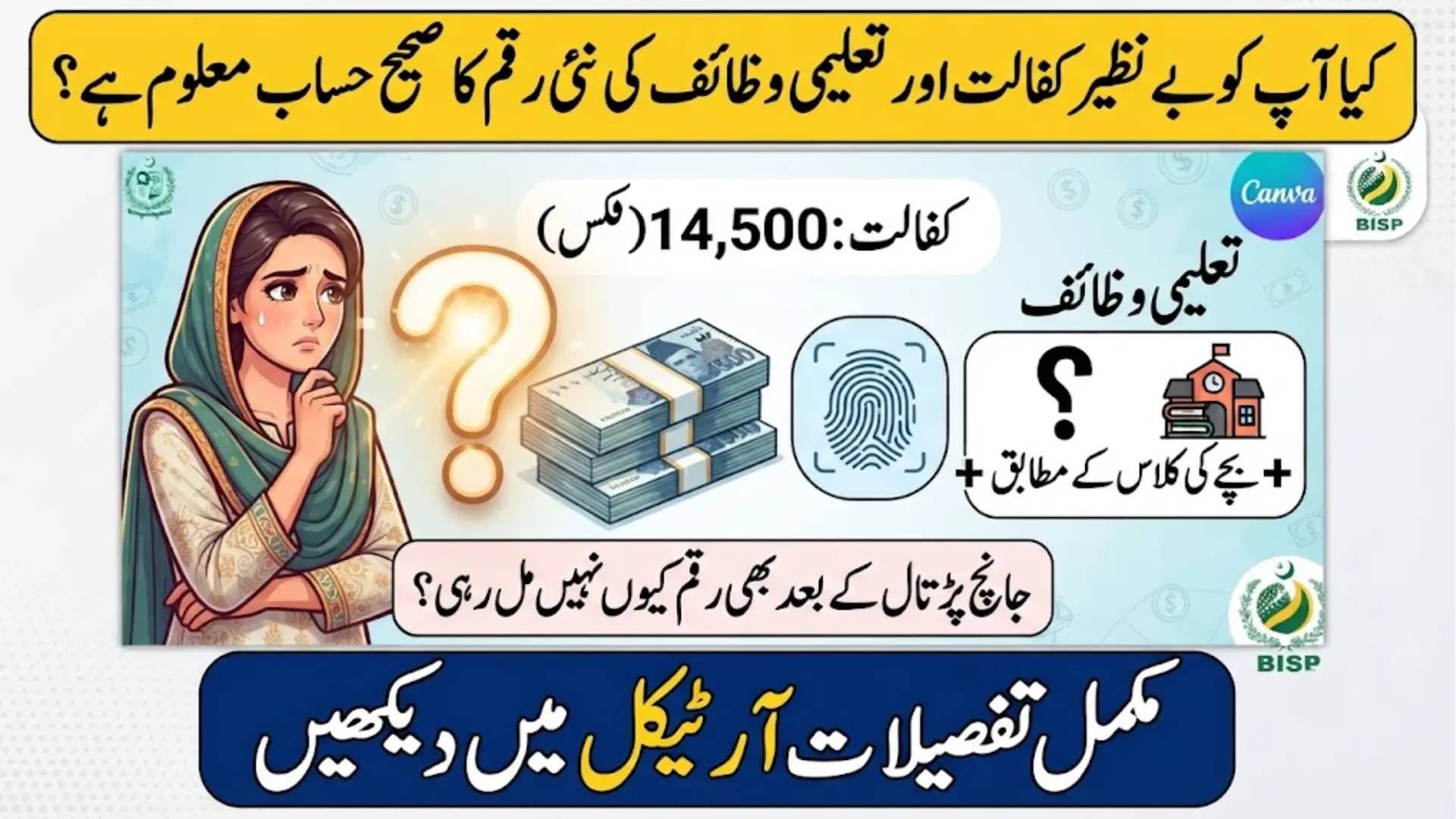
Kafalat + Taleemi Wazaif
Getting marked “eligible” for Benazir Kafalat is only half the process. The other half is verification at the payment stage, which is where many families run into confusion about how much money they’ll actually receive, especially when more than one child is enrolled in Taleemi Wazaif.
This guide walks through how BISP verifies and pays out Kafalat funds, corrects a common math error about combined child stipends, and explains two support mechanisms the Next-of-Kin policy and the grievance system that most guides skip entirely.
How Biometric Verification Works
Once your status shows as eligible, the money isn’t released to your account instantly. BISP uses a Biometric Verification System (BVS) that confirms your fingerprint at the payment point before releasing funds, which prevents someone else from collecting your payment using a stolen or copied CNIC.
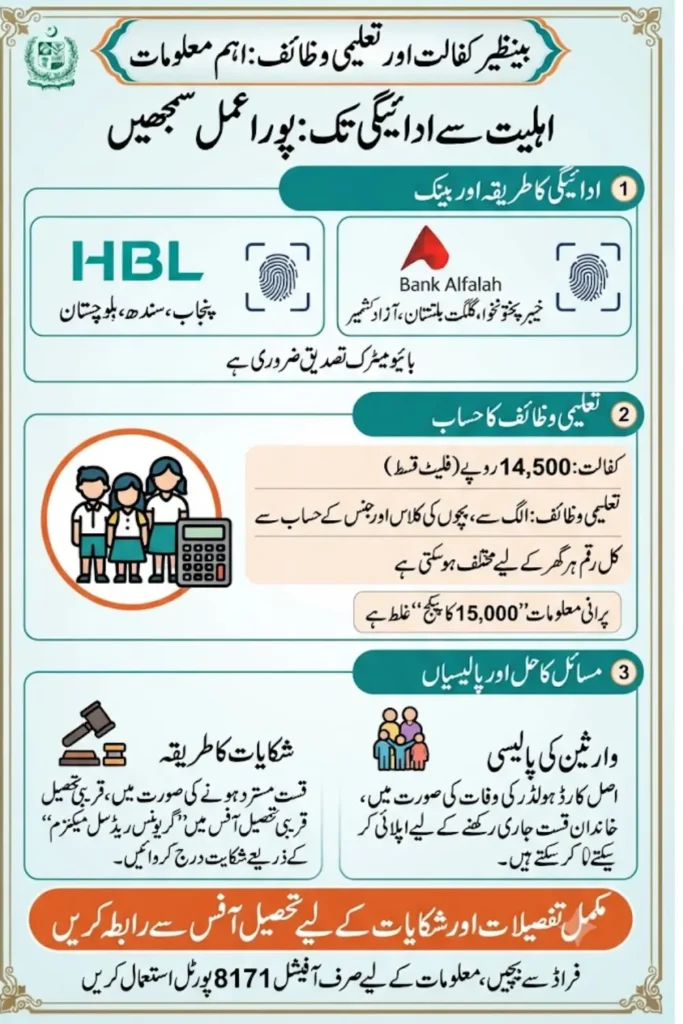
Two partner banks handle this process depending on where you live. Knowing which one applies to your region helps you head to the right kind of payment point instead of wasting a trip.
| Region | Partner Bank |
|---|---|
| Punjab, Sindh, Balochistan | HBL (Habib Bank Limited) |
| Khyber Pakhtunkhwa, Gilgit-Baltistan, AJK | Bank Alfalah |
A growing number of beneficiaries now receive payments through a digital wallet, such as JazzCash, instead of visiting a physical campsite. This shifts the verification step to your phone rather than a fingerprint scanner, but it’s only available where BISP has activated it for your district so far.
Benazir Kafalat + Taleemi Wazaif New Payment Started Check Your Status Online By CNIC
Why “10,500 + 4,500 = 15,000” Is Misleading
Older guides describe Kafalat and Taleemi Wazaif as a fixed combined package, but that’s not how the math actually works. Kafalat is a flat quarterly payment to the mother, while Taleemi Wazaif is a separate, per-child stipend that changes based on the child’s class level and gender.
This means a household with two children in different grades will not simply double a fixed number. Each child’s stipend is calculated on its own, so the household total depends entirely on how many children are enrolled and at what education level, not a flat multiplication.
Kafalat Taleemi Wazaif
Benazir Kafalat and Taleemi Wazaif are not one combined payment, so the total amount depends on your household. The Kafalat portion pays Rs. 14,500 per quarter to the mother, regardless of how many children she has. Taleemi Wazaif is separate and paid per child, with the amount changing based on the child’s class level and gender, so a family with two children in different grades will not simply get double a fixed number. Because these per-child rates are revised from time to time, the safest way to know your exact total is to check your own CNIC on the official 8171 portal rather than relying on a fixed figure from an older article.
A Simplified Example
| Household Situation | What Determines the Total |
|---|---|
| Mother only, no school-age children | Kafalat payment alone |
| Mother with one child in primary school | Kafalat plus that child’s primary-level stipend |
| Mother with two children at different grade levels | Kafalat plus each child’s individual stipend, added separately |
Because exact stipend rates are revised periodically, it’s best to confirm your child’s specific amount through the official portal rather than relying on a fixed number from an older article.
Closest Family Member Policy
A detail rarely covered elsewhere: if a registered beneficiary passes away, her family isn’t automatically cut off from support. BISP has a Next-of-Kin policy that lets eligible family members apply to continue receiving payments through a formal appeal process.
To apply, the family needs to submit the deceased beneficiary’s CNIC, a CNIC cancellation certificate from NADRA, a death certificate from the union council, and the CNICs of the family members applying to continue the benefit. These documents go to the nearest BISP Tehsil Office for processing.
What to Do If a Payment Is Rejected or Delayed
Before assuming something is wrong with your registration, check for these common and fixable causes:
- Your fingerprint didn’t match during biometric verification, often due to worn or damaged prints.
- Your CNIC has expired and needs renewal at NADRA before any payment can be processed.
- Your household’s dynamic survey data is outdated and needs a fresh visit to a Tehsil Office.
- The digital wallet number on file no longer matches your active mobile number.
Filing a Complaint Through the Grievance Redressal Mechanism
BISP has a dedicated Grievance Redressal Mechanism connected directly with its partner banks, which is meant to resolve payment complaints faster than a general helpline call. Use it when a straightforward re-verification hasn’t fixed your issue.
- Visit your nearest BISP Tehsil Office and explain that you want to file a formal complaint, not just a status inquiry.
- Bring your CNIC and any reference number from a previous failed payment attempt.
- Ask for a complaint tracking number so you can follow up without repeating your case from scratch.
- If the issue involves your bank account or wallet specifically, mention the partner bank name so it can be routed correctly.
Conclusion
Being eligible for Benazir Kafalat is just the first step; verification and disbursement have their own process worth understanding. Payments go through HBL or Bank Alfalah, depending on your region; Kafalat and Taleemi Wazaif are calculated separately rather than as one fixed sum, and both a Next-of-Kin policy and a formal grievance system exist for situations most guides don’t mention.
Frequently Asked Questions
1. Why wasn’t my payment released even though my status shows eligible? Eligibility and payment release are separate steps. Biometric verification, an active CNIC, and an updated survey all need to be checked out before funds are disbursed.
2. Do Kafalat and Taleemi Wazaif combine into one fixed payment? No, they are calculated separately. Taleemi Wazaif depends on each child’s class level and gender, so the total varies by household.
3. What happens to Kafalat payments if the registered beneficiary dies? Her family can apply under the Next-of-Kin policy by submitting a death certificate and other required documents at a BISP Tehsil Office.
4. Which bank handles my payment, HBL or Bank Alfalah? It depends on your region. HBL covers Punjab, Sindh, and Balochistan, while Bank Alfalah covers Khyber Pakhtunkhwa, Gilgit-Baltistan, and AJK.
5. What should I do if re-verification doesn’t fix a rejected payment? File a formal complaint through the Grievance Redressal Mechanism at your nearest BISP office and request a tracking number.
Conditions and Registration for Benazir Taleemi Wazifa Joining Procedure 4500 Program